Beautiful, resilient landscapes begin with healthy soil. Organic and ecological landscaping is about more than choosing the right plants or avoiding herbicides—it starts by building living soil that supports healthy plants, stores carbon, improves water infiltration, reduces erosion, and strengthens biodiversity.
Whether you’re a homeowner, gardener, or landscape professional, understanding your soil can help solve common challenges like weed pressure, compaction, drought stress, and poor plant performance.
Soil Health Basics
Regardless of how you are interacting with the land around you, the foundation for healthy soils are the same.
What is Soil Health?
“Soil health is the continued capacity of soil to function as a vital living ecosystem that sustains plants, animals, and humans.”
NRCS
Healthy soil supports plant growth, regulates water, cycles nutrients, and provides a habitat for organisms. Soil is not just dirt; it is teeming with life. Microbes, fungi, and invertebrates play critical roles in the Soil Food Web. Healthy soils maintain a balance between organic matter, minerals, and organisms.
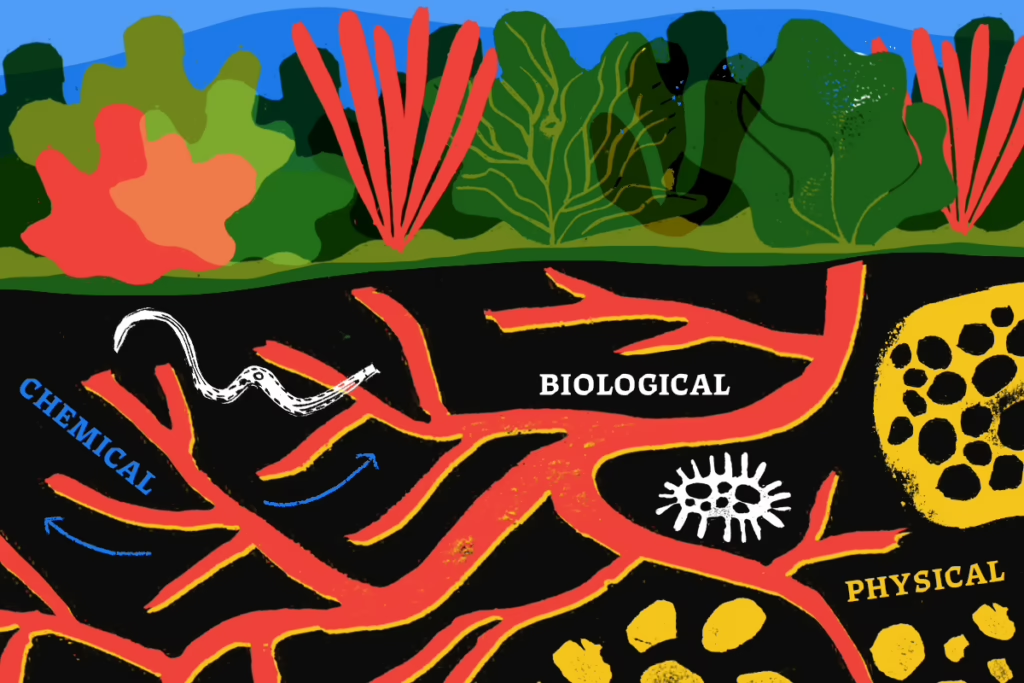
The three pillars of soil health are physical (the structure, texture, compaction, and porosity of the soil), chemical (pH, nutrient availability, and cation exchange capacity), and biological (microbial activity, organic matter decomposition, and soil life).
Organic matter helps improve soil structure and water retention. It aides in feeding soil microbes, and enhances nutrient availability. Compost and mulch can be highly useful in building organic matter in soil.
Key Components of Soil Health
- Soil Structure: The arrangement of soil particles and pores affects water infiltration, root growth, and aeration.
- Organic Matter: Improves soil fertility, moisture retention, and microbial activity.
- Microbial Life: Bacteria, fungi, and other organisms contribute to nutrient cycling and plant resilience.
- Soil pH & Chemistry: A balanced pH ensures nutrient availability for plants.
- Water Retention & Drainage: Proper water balance prevents erosion and supports plant growth.
Soil Health Impacts on Landscapers & Gardeners
Assessing Soil Health in Landscaped Environments
Why Assess Soil Health?
Healthy soil is the foundation of resilient landscapes. Regular soil assessments help identify issues, guide management decisions, and improve plant health. Key benefits of soil assessment include:
- Understanding soil conditions for better plant growth
- Enhancing soil structure, water retention, and nutrient cycling
- Detecting compaction, organic matter levels, and biological activity
Key Soil Health Indicators
Soil health can be evaluated using physical, biological, and chemical indicators.
- Soil Structure: Aggregates, porosity, and root penetration
- Compaction: Measured with a penetrometer
- Water Infiltration: Evaluated using infiltration tests
- Texture: Proportion of sand, silt, and clay
- Microbial Biomass: Assessed using the MicroBIOMETER
- Soil Life: Presence of earthworms, fungi, and microorganisms
- Organic Matter Decomposition: Breakdown of plant residues
- Organic Matter Content: Essential for microbial activity and nutrient retention
- Contaminants: Testing for heavy metals or pollutants if necessary
Soil Health & Technical Assistance Options
The Soil Health Assessment (Soil Carbon) uses quantitative and qualitative metrics to give an overall assessment of the level of biodiversity and biological activity in the soil, which can be used as a proxy to assess soil carbon levels. These tests will help you get an idea of how well your soils are supporting life and storing carbon.
- Infiltration Test: How quickly does water penetrate the soil?
- Soil Texture Test: Sand, silt, or clay content
- Compaction Test: Use a penetrometer to measure soil resistance
To conduct a Soil Health Assessment on your own, please consult the NOFA/Mass Soil Carbon Proxy Test Manual.
Soil Chemical Testing is the first step into balancing your soil mineral profile.
- Soil nutrient analysis (macro and micronutrients)
- Organic matter content evaluation
- Contaminant screening (if necessary)
To determine if your soil has the right biology to support your intended crops, a Soil Food Web Analysis will give more detailed information on the microbes in your soil.
- Presence of earthworms, fungi, and microbial diversity
- Decomposition of organic matter.
Tools such as the microBIOMETER can be used to help assess the microbial health of your soil.
Soil Improvement Strategies
- Apply compost and mulch to enrich soil biology and structure
- Use cover crops or green manure to prevent soil degradation
- Incorporate biochar to improve carbon storage and microbial habitat.
- Apply compost teas and extracts to introduce beneficial microbes.
- Use mycorrhizal inoculants to boost root-fungal associations.
- Maintain diverse plant species to support a rich microbial ecosystem.
- Avoid excessive foot and machine traffic
- Use aeration tools to relieve compaction
- Incorporate deep-rooted plants to naturally break up compacted layers
- Increase soil aggregates through organic matter additions
- Use perennial plants to promote long-term soil stability
- Implement rain gardens and bioswales to enhance infiltration
- Reduce synthetic fertilizer and pesticide use
- Apply organic amendments such as rock dust and seaweed extracts
- Use integrated pest management (IPM) strategies to balance soil ecology
Additional Resources
- Article: Why You Should Use Compost Tea This Spring
- Article: Worms at Work: Your Guide to Indoor Composting
- Video: Making Nutrient Bypass Foliar Spray
- Video: Compost Tea Brewing: An Introductory Overview
- Video: Soil Amendments for Organic Farms
The NOFA IC’s Organic Landcare Program has even more resources available to explore.

Organic Land Care
Established in 1999 by a group of landscape professionals, scientists, educators and concerned citizens formed the NOFA Organic Land Care Committee to extend the vision and principles of organic agriculture to the care of landscapes. The Committee drafted the first organic land care standards in the United States and offered the first organic land care accreditation course.
Today, NOFA’s Standards for Land Care: Practices for Design and Maintenance of Ecological Landscapes is revised annually by NOFA’s Organic Land Care Committee.
Ecological Landscape Design
Ecological landscape design promotes sustainable land management by working with natural systems. It integrates soil health, biodiversity, and water management to create resilient landscapes.
- Soil First Approach: Prioritize soil health to support plant and ecosystem vitality
- Right Plant, Right Place: Match plant species to site conditions to reduce inputs
- Support Biodiversity: Integrate native species and pollinator habitats
- Water Management: Utilize rain gardens, permeable surfaces, and mulching
- Minimize Disturbance: Reduce tilling, promote cover cropping, and preserve soil structure
- Organic Amendments: Use compost, mulch, and biochar to boost fertility
- Minimal Disturbance: Adopt no-till practices and aeration
- Diverse Plantings: Introduce perennials and native species to support soil health
- Healthy Root Zones: Maintain proper plant spacing and use mulches
- Rain Gardens & Bioswales: Manage runoff and prevent erosion
- Permeable Surfaces: Reduce compaction and improve infiltration
- Rainwater Harvesting: Capture and reuse water for irrigation
- Xeriscaping: Select drought-tolerant plants for water conservation
Partner Resources
- Ecological Landscape Alliance
- Massachusetts Pollinator Network
- Regenerative Design Group
- Landscape Interactions
- Organic Landcare
Massachusetts Healthy Soils Action Plan and Healthy Soils Initiative
This work was developed under the guidance of the Massachusetts Healthy Soils Action Plan, and funded by the Health Soils Initiative.
The Healthy Soils Initiative was developed over the past four years under the direction of the Commission for Conservation of Soil, Water & Related Resources with crucial input from a steering committee with expertise in soils across five land use categories: farms, forests, wetlands, lawns and other developed open spaces, and impervious areas (buildings, roads, and parking lots).
This event is supported by Office of Energy & Environmental Affairs in order to provide a soil health curriculum for homeowners and landscapers, implementing healthy soil practices outlined in the Healthy Soils Action Plan, including turf best practices, nutrient management, tree planting, and SOC testing.
Questions? Contact soilhealth@nofamass.org.